
By Pinacate Tours · Tour operator based in Hermosillo, Mexico. Information about our experiences and advice for preparing your visit.
Drag to look around
Noche de Estrellas (new moon)
2026
2027
Dunas con la Luna (full moon)
2026
2027
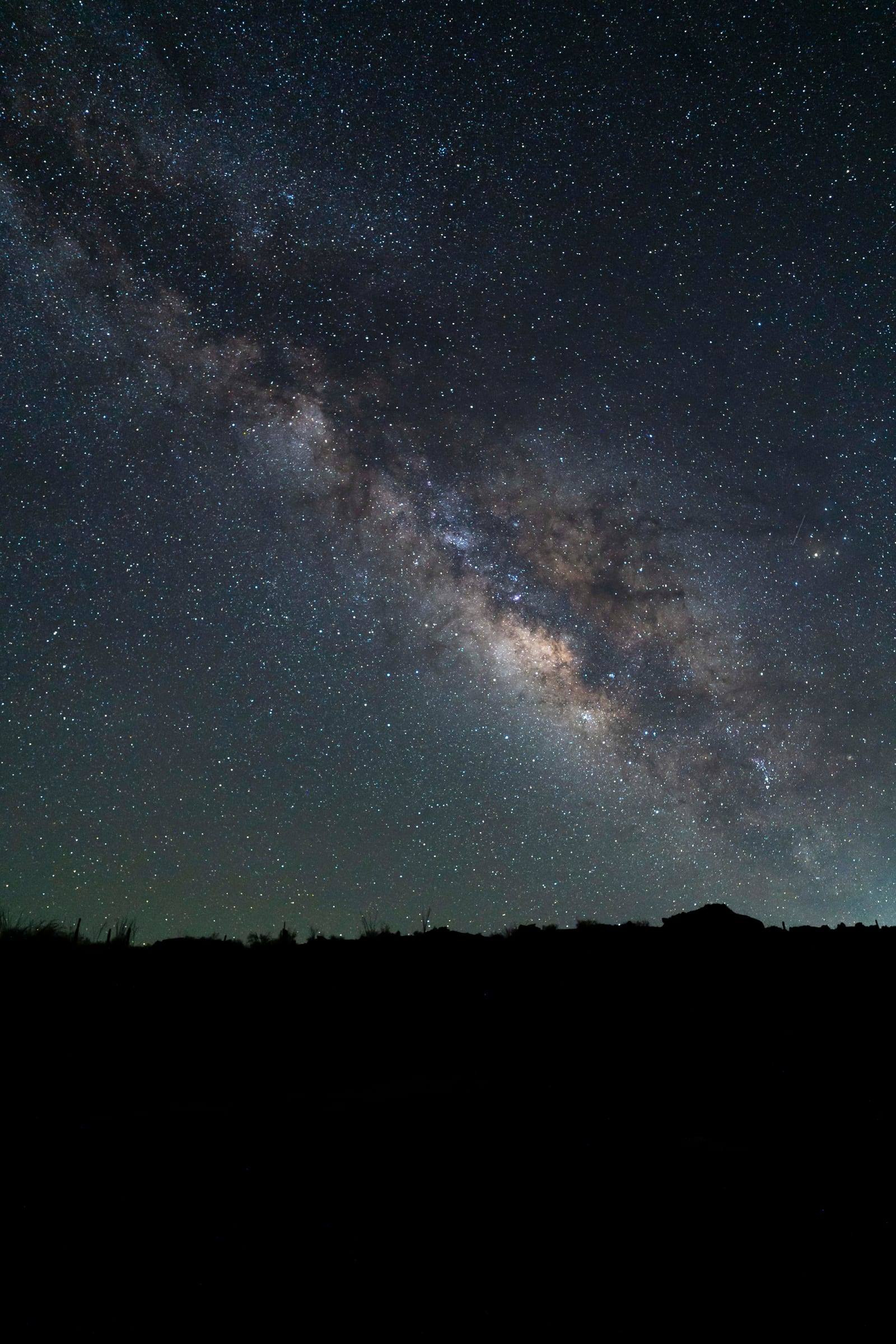
Positions of the Sun, the Moon, the guide stars and the Milky Way calculated for the reserve, in Sonora time (UTC−7). The landscape is illustrative. Milky Way photograph: ESO/S. Brunier (CC BY 4.0).
To see the Milky Way in El Pinacate, look for a dark night with little interference from the Moon and a clear sky. If what you want to see is its brightest central region, the season and the time of night matter too. A winter departure does not offer the same view as a summer night.
On Noche de Estrellas we travel from Hermosillo to spend two days and one night in the reserve, with camping, a stargazing talk and a telescope. Dates are set close to the new moon; check the sky conditions on the page for each departure.
The Milky Way and the galactic centre are not the same thing
The Milky Way is our galaxy. From a dark place, its combined light appears as a faint band across the sky. The galactic centre is the dense, bright region that usually stands out in photographs, towards Sagittarius.
That part is not visible all night, nor all year round. So before choosing a date, it helps to be clear whether you want to see a starry sky, recognise the band of the galaxy or photograph its central region.
What changes during the year
The following table is a guide for planning. For the times on a specific date, use the simulator and the departure page; the calculations do not predict cloud and do not guarantee visibility.
| Time of year | What to check for observing the galactic centre |
|---|---|
| February to April | The windows are usually in the small hours, before dawn |
| May to August | There are wider night-time windows, but check the actual operating calendar and trip conditions |
| September and October | Check the window early in the night; the centre sets earlier |
| November to January | Do not choose these dates expecting the same view of the galactic centre as in summer |
NASA explains how to observe the galaxy from dark skies in its skywatching recommendations. The windows given here are a seasonal guide; the times change every day.
What you can see in winter
The winter sky has other stars of the show. You can recognise constellations such as Orion and Taurus and, depending on the time and conditions, observe clusters and other objects. The band of our galaxy in other directions is fainter than the central region.
A good winter night can be a great observing experience without offering the photograph of the galactic centre you had in mind. NASA presents some objects from that season in its winter stargazing guide.
Why the Moon matters
Moonlight makes it hard to pick out faint details in the sky. To choose a night, check its phase and also when it rises and sets: there can be a dark window even if it does not coincide exactly with the new moon.
Noche de Estrellas focuses on astronomy and dark skies. Dunas con la Luna offers a different experience: walking the dunes at sunset and enjoying the moonlit landscape. It includes no stargazing talk or telescope, and it is not the one to choose for the same view of the Milky Way.
Sonora Salvaje has Starry Nights and Full Moon departures. The version depends on the calendar date; it cannot be changed individually within a departure.
What the simulator shows
The simulator on this page lets you explore the position of the sky. The calendar pages add calculated times of darkness and moonlight for each trip. They are an aid to choosing, not a weather forecast or a promise of what you will see.
Night photographs can also show more detail and colour than the naked eye. Compare your expectations with the aim of the trip: observing, learning or photographing each need different preparation.
What stargazing with Pinacate Tours includes
Noche de Estrellas includes a stargazing talk, use of a telescope and night photography. What is observed depends on the date, the time and the sky conditions. Seeing craters on the Moon requires it to be visible; that observation is not promised on every new-moon departure. Our tours, including the talk, are guided in Spanish only.
See the itinerary and what is included, and bring warm clothes to stay outdoors at night. Our packing list for El Pinacate separates the gear that is included from what you need to bring or rent.
How to choose your departure
- Decide whether your priority is the galactic centre, a meteor shower or getting to know the night sky.
- Open the departure calendar and check the page for the dates that suit you.
- Compare the dark hours with the Moon’s presence.
- Confirm availability and expectations with the team before booking.
If you are after meteors, see the departures that coincide with the peak of a meteor shower. To combine stargazing and hiking, also see the best time to visit El Pinacate.
Ready to see the desert at night?
See the upcoming departures or message us and we will help you choose.
Message us